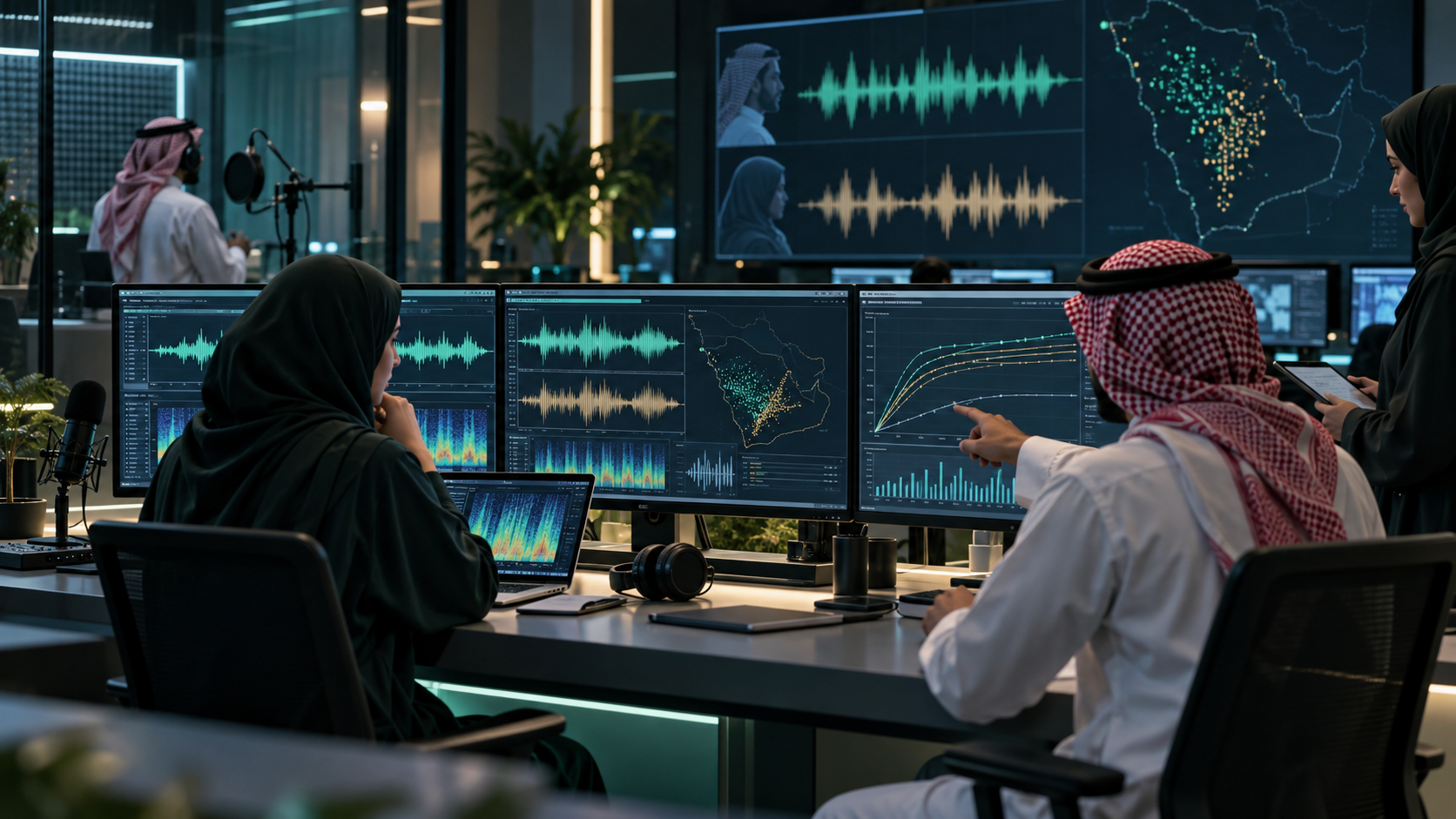
NVIDIA has published a technical account of fine-tuning its Nemotron 3.5 automatic speech-recognition model for Saudi Arabic dialects using the Saudi Audio Dataset for Arabic, known as SADA. The work focuses on Najdi and Hijazi speech and offers a concrete example of how regional data can improve the performance of multilingual models in dialects that are often underrepresented in general training corpora.
According to NVIDIA’s report, the target test split recorded a word-error rate of 55.05 percent before fine-tuning and 29.96 percent after training on 133.7 hours of curated Najdi and Hijazi speech. The company also reports a smaller improvement on an English holdout and says other Arabic dialects were not degraded in the experiment. These are vendor-reported results on the company’s test setup, not an independent benchmark or a guarantee of performance in every Saudi deployment.
The experiment is important because speech recognition is highly sensitive to accent, vocabulary, recording conditions and transcription quality. A model that performs well on Modern Standard Arabic or a dominant global language may still struggle with local pronunciation, code-switching, names and noisy real-world audio. SADA gives developers a way to measure and address that gap with data connected to Saudi speech communities.
NVIDIA describes a training recipe that combines targeted data curation, weighted replay from a broader multilingual dataset, duration-based batching and partial encoder unfreezing. The objective is not only to improve the target dialects but to preserve the model’s wider capabilities. That balance matters for products serving users who move between dialects, English and formal Arabic in the same interaction.
The report does not establish commercial adoption, government procurement or production performance in Saudi Arabia. The next evidence should include independent testing, evaluation across speakers and regions, latency and cost measurements, privacy controls and examples from real services. Dataset provenance and consent are also important when speech recordings are used to train public-facing systems.
For the GCC, the development is a useful model of regional AI localisation: identify a measurable language gap, curate relevant data, publish the method and test for unintended regressions. Saudi dialect support will become strategically valuable only when these improvements survive independent evaluation and translate into dependable Arabic voice services.