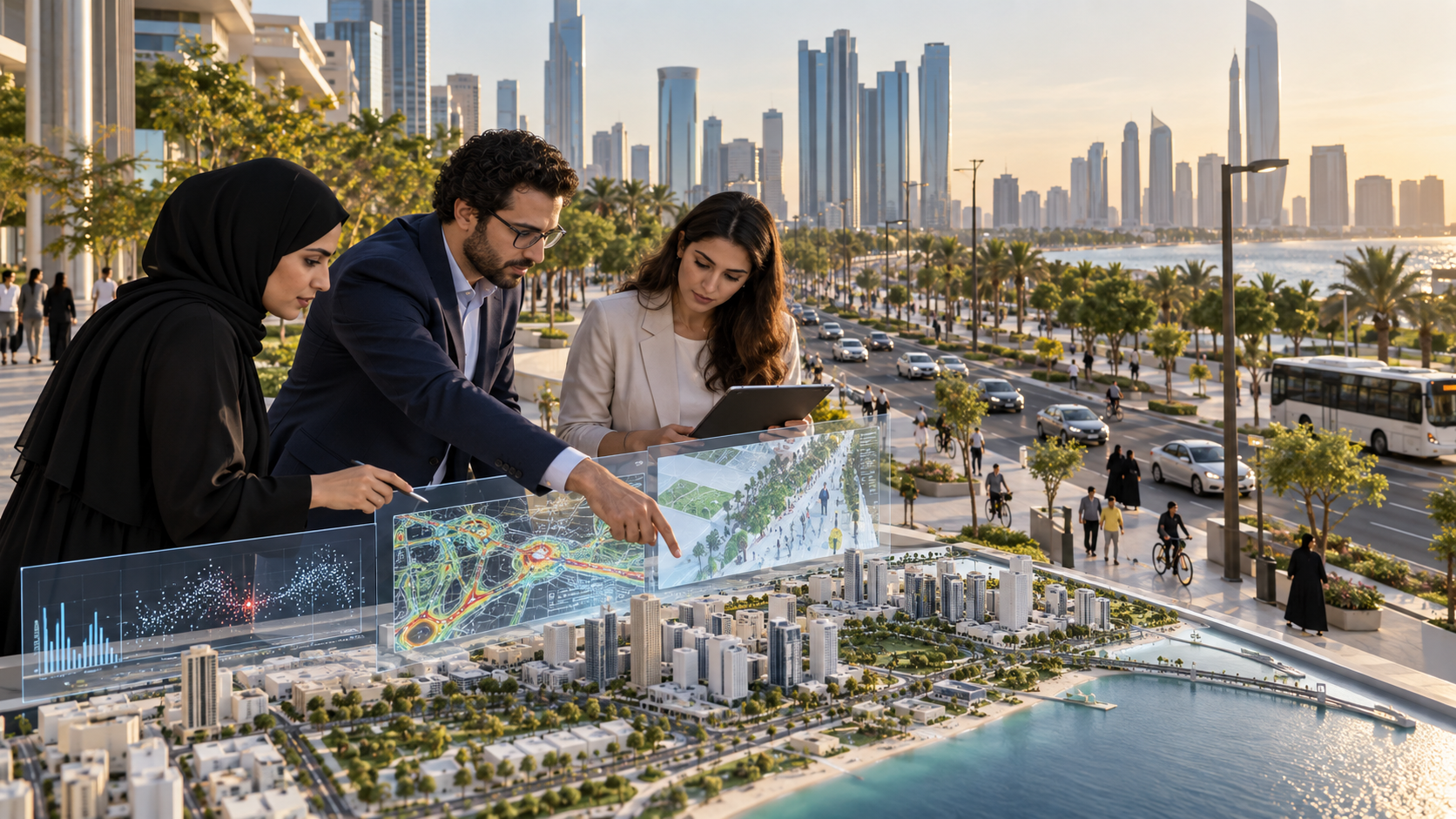
Abu Dhabi’s Department of Municipalities and Transport has expanded its partnership with the Massachusetts Institute of Technology’s Senseable City Consortium to apply research and artificial intelligence to urban planning, mobility and environmental conditions. The agreement was announced during the opening day of the Liveability and Investment Exhibition in Abu Dhabi and builds on collaboration established in 2024.
Two proofs of concept are nearing completion. Emission AI uses dashcam footage and artificial intelligence to estimate vehicle emissions, while Exposure AI assesses pedestrians’ exposure to traffic emissions. The projects are designed to give planners a more detailed evidence base for decisions about mobility, street design and healthier public spaces.
The partnership is also exploring AI applications beyond traffic analysis. Proposed projects include tools to guide tree selection and planting, with the aim of supporting cooler and healthier neighbourhoods, as well as work on urban lighting and night-sky visibility. These are decision-support applications: the value lies in improving the quality and timeliness of evidence available to city authorities rather than replacing planning judgment.
The announcement does not provide independent performance measures for the two proofs of concept, such as accuracy against ground measurements, geographic coverage, processing cost or the rate at which officials accept or override system recommendations. Those details will matter if Abu Dhabi wants to move from research prototypes to citywide operational services.
The work nevertheless represents a useful pattern for Gulf smart-city programmes. It links AI to a defined public problem, uses data from the physical environment and creates a pathway from university research to government decisions. It also raises practical questions about privacy, data governance, model drift and how residents can understand the systems influencing their streets.
For the region, the partnership is a reminder that urban AI is not limited to autonomous vehicles or surveillance. Emissions, heat, tree cover, pedestrian exposure and lighting are measurable planning variables. The next phase will be judged by whether those measurements produce safer, cleaner and more liveable outcomes that can be independently evaluated.