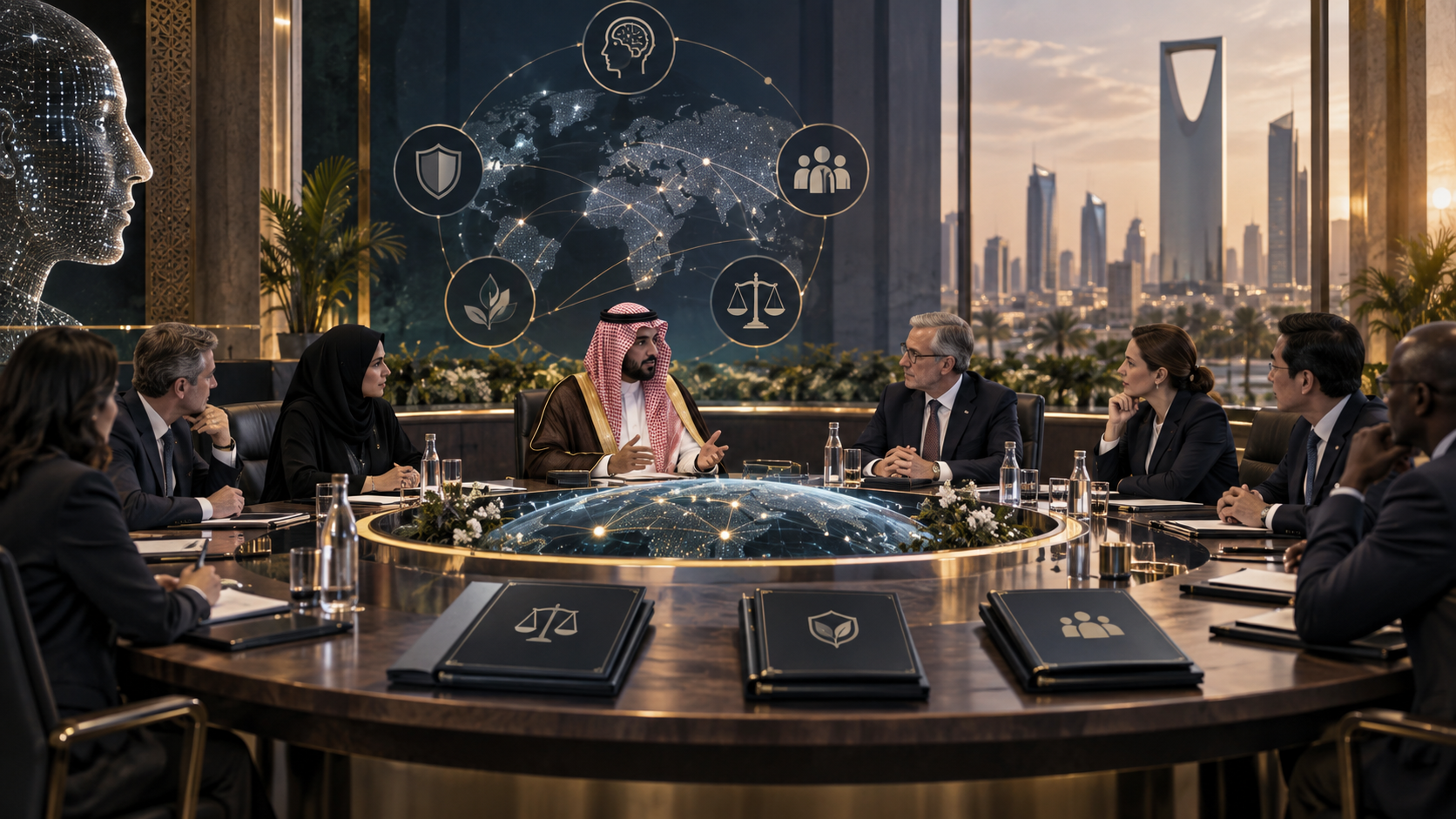
Saudi Arabia joined the Global Partnership on Artificial Intelligence in February 2026, according to SDAIA’s official news updates. The move adds the Kingdom to a multilateral forum focused on responsible development, international cooperation and practical policy approaches for artificial intelligence.
Membership is relevant to Saudi Arabia’s broader effort to establish AI as a national capability. The Kingdom is investing in models, compute, data centres, skills and enterprise applications, while also seeking a role in the rules and standards that shape how these systems are developed and deployed. Participation in an international partnership creates a route for sharing experience and comparing national approaches.
Responsible AI cooperation covers more than ethical principles. It can include evaluation methods, safety practices, data governance, transparency, workforce preparation and the management of risks associated with high-impact systems. For a country scaling AI across government and strategic industries, those areas become operational requirements rather than abstract policy questions.
SDAIA has also highlighted responsible AI, deepfake risks and international ethics cooperation during Saudi Arabia’s 2026 Year of Artificial Intelligence. Joining a multilateral body therefore fits a broader governance agenda that seeks to connect domestic capability building with global conversations about trust and accountability.
The announcement does not mean that membership automatically creates a Saudi AI regulation or proves that every domestic system meets international standards. It creates an institutional channel for cooperation. The value will depend on the experts Saudi Arabia contributes, the practices it adopts, and whether international principles become visible in procurement, evaluation and public-sector deployment.
Future coverage should follow Saudi participation in working groups, published commitments, national policy changes and any concrete research or capacity-building projects that emerge from the partnership.
Saudi participation may also give the partnership a more direct view of Gulf operating conditions, including Arabic-language systems, public-sector scale, national data controls and the needs of strategic industries. Those are areas where international principles must be translated into implementation guidance rather than remaining at the level of declarations.
The responsible editorial standard is to distinguish membership from compliance. The announcement is evidence of Saudi Arabia entering a policy network; it is not evidence that all domestic AI systems have been independently assessed or that specific governance reforms have already taken effect.