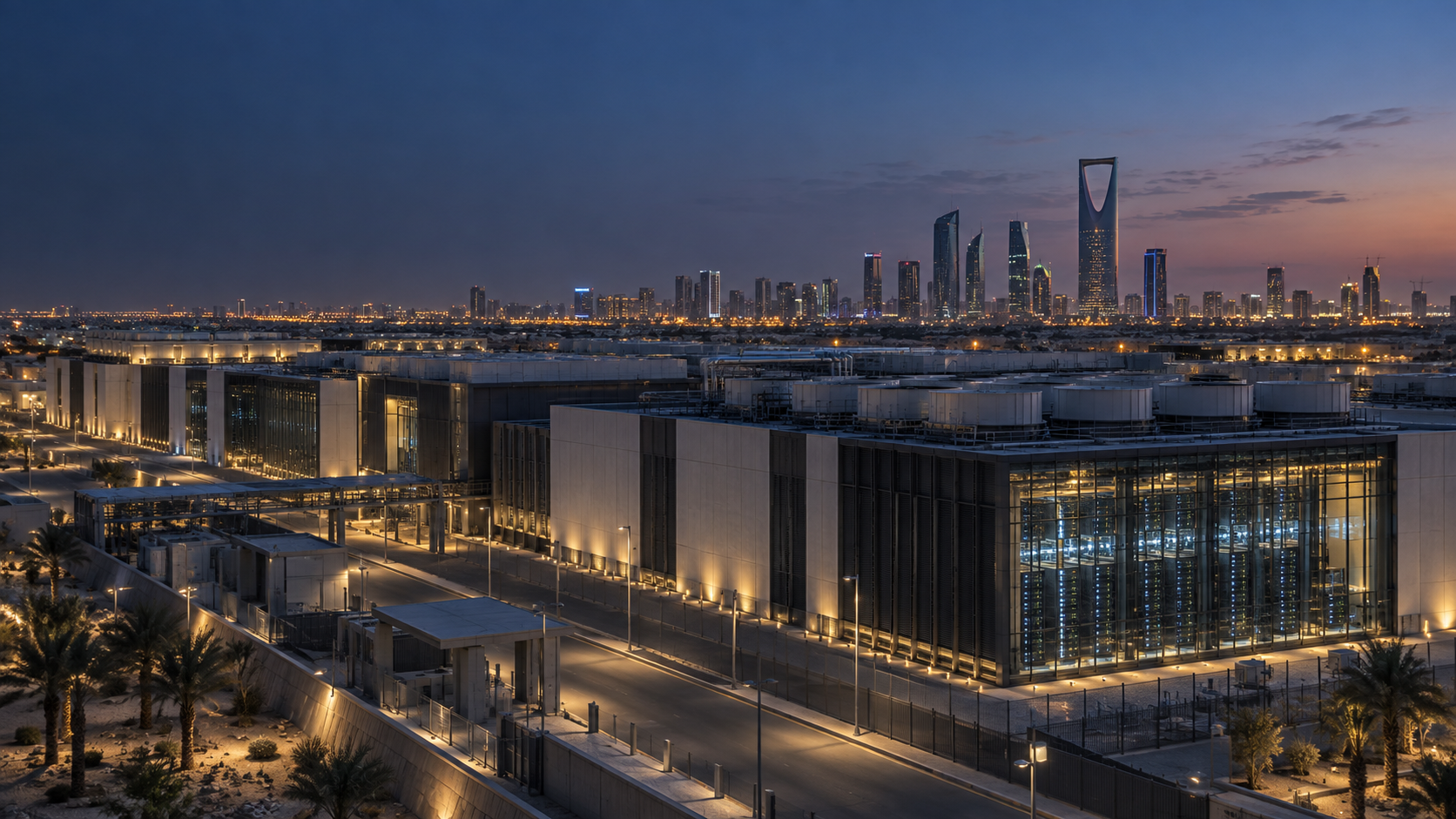
The Saudi Council of Ministers, chaired by Crown Prince Mohammed bin Salman, formally decreed 2026 as the official 'Year of Artificial Intelligence' across the Kingdom. Supervised by the Saudi Data and Artificial Intelligence Authority (SDAIA), the designation transforms emerging technology from a sector-specific investment target into a comprehensive national operating mandate under Vision 2030. Alongside the announcement, the government inaugurated 'Hexagon' in Riyadh, confirmed as the world's largest sovereign government data center, boasting 480 megawatts of dedicated capacity across a 30-million-square-foot hardened campus.
The Hexagon facility represents a structural shift toward sovereign computing independence. Engineered to Tier IV standards, the supercomputing hub provides fault-tolerant power, closed-loop liquid cooling, and sovereign data residency for hundreds of state ministries, national security agencies, and sovereign wealth entities. Rather than relying on overseas endpoints or multi-tenant commercial hyperscalers with foreign jurisdictions, Saudi Arabia is consolidating its core administrative databases, civil registers, and frontier foundation models inside domestic, hardened physical perimeters.
This physical footprint is matched by aggressive capital deployment. In 2025 alone, Saudi AI firms secured over $9.1 billion across 70 institutional transactions, supported by the Public Investment Fund's dedicated vehicle HUMAIN. Concurrently, SDAIA's SAMAI upskilling initiative has already engaged more than one million citizens in structured artificial intelligence training programs, spanning foundational literacy for civil servants to high-level engineering curricula. The initiative's newly unveiled identity—a palm tree interwoven with binary circuit paths—symbolizes this synthesis of national cultural identity with deep computational autonomy.
The operational benchmark for 2026 will now be measurable adoption and utilization efficiency. Key performance indicators will focus on the migration of legacy government workflows into Hexagon's private clouds, latency benchmarks for real-time public services, and the commercialization of proprietary Arabic models such as ALLAM across regional enterprise sectors. By linking massive electrical and physical infrastructure with institutional mandate and workforce readiness, Saudi Arabia has set a clear precedent for how sovereign states can orchestrate technological capability at continental scale.